
WELCOME BONUS 300%
UP TO €2000 + 100
FREE SPINS
UP TO €2000 + 100
FREE SPINS
Home → Blackjack
Blackjack at Casino Winshark: Variants, Rules and Payouts
What Push Means: Stake Returns to You
A push occurs when the player and dealer hold equal hand values, resulting in a stake return without loss or gain. This mechanism is distinct from insurance bets, which pay 2:1 but carry a house edge of 7.47% due to their separate nature. Players retain their original wager amount during these neutral outcomes, avoiding the depletion of their bankroll on tied hands.
The frequency of pushes increases with the number of decks used, affecting the overall volatility of the game session. Unlike standard wins that pay 1:1, a push generates no profit, meaning the theoretical return remains unchanged for that specific round. This rule protects the player from losing money on identical final totals compared to the dealer's upcard and hole card combination.
Late surrender allows players to forfeit half their bet after the dealer checks for blackjack, reducing the loss to 50% instead of the full amount. This option improves the RTP by approximately 0.08 percentage points compared to playing out the hand blindly. Early surrender is rarer but offers a greater advantage of up to 0.6 percentage points if available.
Six Card Charlie Pays Immediately with Six Cards
Standard rules require drawing until reaching at least seventeen, yet some variants award automatic wins for five or six cards under twenty-one. This high return rate relies heavily on the absence of restrictive side bets or reduced payout structures like 6:5.
Blackjack Liberal Vegas Strip offers the most favorable rule combination including resplitting and late surrender for a house edge of only 0.28%. Players should verify if such a bonus exists, as its inclusion significantly boosts the expected value beyond the standard 3:2 payout.
Infinite Blackjack from Evolution supports unlimited seats and features side bets like Any Pair with an RTP of 99.47%. While the main game adheres to standard winning conditions, the presence of multiple side bets can alter the overall volatility. The base strategy remains mandatory to maintain the optimal mathematical expectation against the dealer's soft 17 hit or stand variation.
Insurance vs Even Money on Own Blackjack
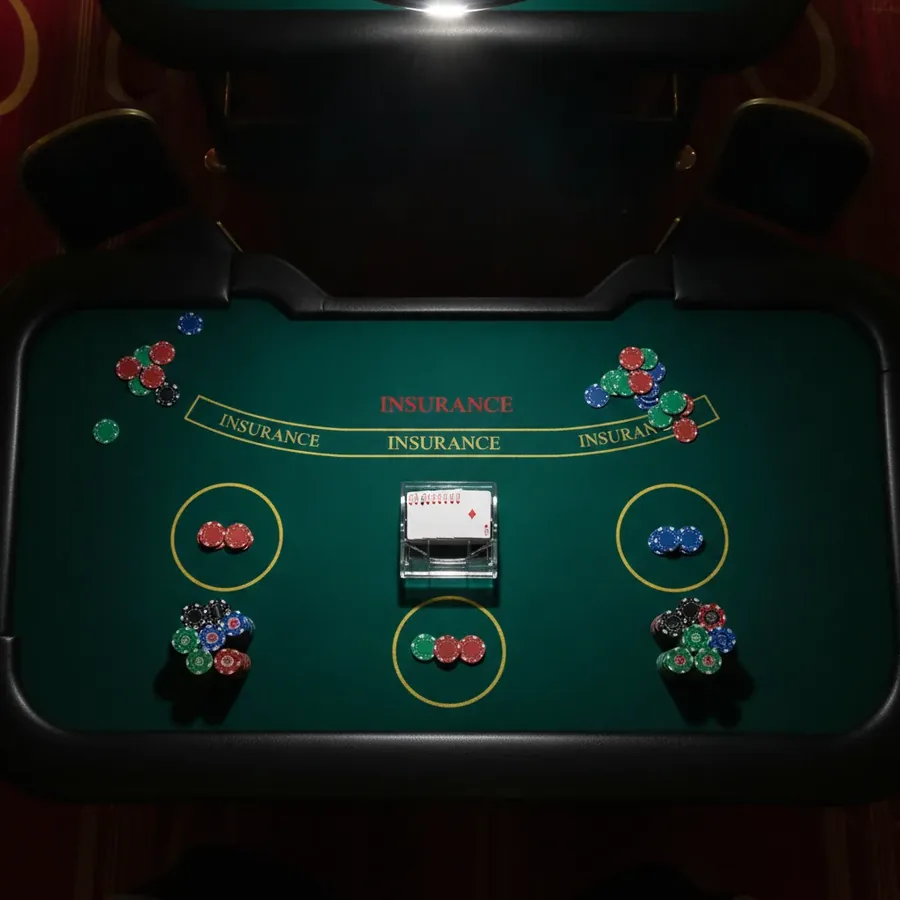
Insurance is a side bet offered when the dealer shows an ace, paying 2:1 if the dealer has a ten-value hole card. The house edge for this wager is substantial at 7.47%, making it mathematically unfavorable for non-counters. Players are advised to always decline this bet unless they have tracked a true count of plus three or higher.
Even money is essentially taking insurance on a natural blackjack, guaranteeing a 1:1 payout regardless of the dealer's outcome. This eliminates the possibility of a push but also removes the potential for the standard 3:2 bonus win. For a $10 bet, even money secures $10 profit, whereas waiting reveals whether the dealer also holds blackjack.
The statistical difference between taking even money and declining it favors the long-term player who waits for the result. By rejecting insurance, the player avoids the 7.47% house edge associated with the side bet structure. This decision aligns with basic strategy, which prescribes ignoring insurance offers in all standard deck configurations except during specific counting scenarios.
16 vs 10 played incorrectly: most common error
Hitting on a hard sixteen against a dealer ten is a frequent mistake that ignores the probability of busting with any card seven or higher. Basic strategy dictates standing on this total because the dealer is likely to bust or end with a strong hand anyway. Drawing a card risks immediate loss more often than the marginal benefit of improving a weak hand.
The house edge for Blackjack 6 Decks stands at 0.46% when players strictly follow the recommended baseline strategy. Deviating from this path by hitting on sixteen against a ten increases the casino's advantage significantly. Adherence to the chart ensures the lowest possible variance and maximizes the theoretical return over thousands of hands.
Soft 17 rules impact how dealers play their hands, with H17 adding 0.22 percentage points to the house edge compared to standing. This rule change makes player decisions on marginal hands like sixteen even more critical for minimizing losses. Players must adjust their expectations knowing that the dealer has a slightly higher chance of completing a winning total.
Soft 17: Dealer Hits or Stands
When the dealer hits on soft 17, they draw an additional card, which increases the risk of busting but also improves their final hand strength. This rule adds 0.22 percentage points to the house edge compared to tables where the dealer stands on all seventeen totals. Players face a slightly tougher opponent, requiring stricter adherence to basic strategy to maintain optimal returns.
Resplitting Aces (RSA) improves the player's position by allowing them to split pairs of aces into two new hands, each starting with an ace. This rule reduces the house edge by 0.08 percentage points, offering a modest but valuable advantage. It provides more opportunities to build strong hands from low-value starting pairs, enhancing the overall gameplay potential.
Double After Split (DAS) permits players to double their bet on any hand created after splitting, excluding aces in many cases. This option lowers the house edge by approximately 0.14 percentage points, making it a crucial feature for serious strategists. The ability to capitalize on favorable splits directly impacts the long-term profitability of the blackjack variant selected.
Blackjack variants at a glance
| Variant | Payout | House edge | Rule | Bet range |
|---|---|---|---|---|
| Blackjack Ein Deck, klassische Regeln, 3:2 | 99.85% | 0.15% | Weniger Decks = niedrigerer Vorteil; ein Deck gibt ca. −0.48 Prozentpunkte gegenüber 8 Decks. Oft durch 6:5 Auszahlung kompensiert. | Blackjack 3:2, Gewinn 1:1 |
| Blackjack Split / Double / H17 – Regel-Effekte | n.a. (Regel-Modifikatoren) | H17 +0.22 Prozentpunkte; RSA −0.08 Prozentpunkte; DAS −0.14 Prozentpunkte | Dealer Hits Soft 17 verschlechtert RTP um 0.22 Prozentpunkte; Resplit Aces verbessert um 0.08 Prozentpunkte; Double After Split verbessert um ca. 0.14 Prozentpunkte; 6 Decks statt 8 – ca. 0.02 Prozentpunkte. | Double – Einsatz ×2 mit einer Karte; Split – bis 4 Hände; Ass-Split meist mit einer Karte. |
| Blackjack 6 Decks, S17, DAS, DOA, Auszahlung 3:2, Basisstrategie | 99.54% | 0.46% | Dealer steht auf Soft 17; Verdopplung auf jeder Zweierkarte; Verdopplung nach Split erlaubt; keine Aufgabe. Basisstrategie ist für diesen Wert zwingend | Blackjack 3:2, normaler Gewinn 1:1, Insurance 2:1 |
| Blackjack Insurance / Versicherung (6–8 Decks) | 92.53% | 7.47% | Separate Nebenwette bis 50% der Hauptwette, wenn der Dealer ein Ass hat. Basisstrategie schreibt IMMER Ablehnung vor (außer Karten zählen bei True Count ≥ +3). Bei einem Deck Vorteil ≈ 5.88% | Insurance 2:1 |
| Blackjack Liberal Vegas Strip (liberale Regeln, 3:2) | 99.72% | 0.28% | Günstigste Regelkombination: S17 + DAS + Resplit + Late Surrender. Standardabweichung 1,15 | Blackjack 3:2, Gewinn 1:1 |
| Blackjack Auszahlung 6:5 statt 3:2 (6 Decks) | 98.15% | 1.85% | Ersatz von 3:2 durch 6:5 fügt exakt +1.39 Prozentpunkte zum Vorteil des Casinos hinzu – stärker als jede andere Regeländerung. Bei $10 Einsatz zahlt Blackjack $12 statt $15. | Blackjack 6:5, Gewinn 1:1 |
Statistics display saves the last 100 rounds
The statistics display saves the last 100 rounds, which provides a limited snapshot of recent activity rather than long-term performance metrics. This finite window excludes data from previous sessions, meaning players cannot rely on these figures to predict future outcomes or verify historical accuracy for any extended period. The restriction ensures that transient patterns do not mislead users into believing short-term variance represents the actual theoretical return over hundreds of thousands of spins.
Infinite Blackjack offers an RTP of 99.47%, but this specific percentage applies to the entire game structure and is not broken down by the individual rounds stored in the local history. The live table allows unlimited seats with bets ranging from 1 to 5,000 EUR, creating a high-volume environment where the displayed statistics reset frequently as new hands are dealt continuously without interruption.
Lightning Blackjack features multipliers up to 25x on won hands, yet the statistical log only records the final outcome of each round without isolating the impact of these bonus triggers. Since the game uses unlimited players and variable payout structures, the saved rounds do not reflect the true volatility or the potential for massive wins that occur when lightning bolts strike during play.
Continuous Shuffling Machine shuffles after each round
A Continuous Shuffling Machine shuffles after each round, which eliminates card counting opportunities and increases the effective house edge compared to manual dealing methods using physical decks. This mechanical process ensures that every hand starts with a freshly randomized shoe, preventing players from tracking removed cards to gain a strategic advantage in games like Blackjack Insurance or standard main bets.
Blackjack Insurance carries a house edge of 7.47% when played with six to eight decks, a figure that remains constant regardless of the shuffling method because the machine resets the composition immediately. Players who follow basic strategy must always decline this side bet, as the continuous shuffle prevents any deviation from optimal play that might otherwise exploit deck penetration or remaining card distributions.
Infinite Blackjack utilizes this technology to support its unlimited seating capacity while maintaining an RTP of 99.47% for the base game. The rapid reshuffling reduces the time between hands significantly, allowing for more decisions per hour but also accelerating the rate at which the mathematical house advantage is realized across all betting limits from one to five thousand euros.
Splitting tens costs expected value: better stand
Splitting tens costs expected value because two separate hands starting with ten each have a lower probability of winning than a single strong hand totaling twenty. In Blackjack Ein Deck with classic rules and a 3:2 payout, standing on twenty yields an RTP of 99.85%, whereas splitting reduces the overall return due to the increased risk of busting or losing both resulting hands against dealer upcards.
Liberal Vegas Strip rules offer an RTP of 99.72% with favorable conditions like S17 and DAS, but splitting tens remains a negative expectation move even under these optimal settings. The standard deviation of 1.15 indicates moderate volatility, yet the mathematical certainty of holding a twenty outweighs the speculative chance of improving two weak hands through additional draws from the shoe.
Insurance bets pay 2:1 but carry a house edge of 7.47%, making them poor value alongside suboptimal main game decisions like splitting tens. When combining a high-edge side bet with a negative EV main action, the cumulative loss accelerates rapidly, especially in tables offering 6:5 payouts which add another 1.39 percentage points to the casino's advantage over the player.
Error insurance: 7 percent additional house edge
Error insurance refers to the substantial cost associated with taking insurance bets, which adds approximately 7 percent to the house edge when calculated incorrectly or taken unnecessarily. Blackjack Insurance pays 2:1 but requires a separate side bet up to fifty percent of the main wager, statistically guaranteeing long-term losses unless the player employs advanced card counting techniques with a true count of plus three or higher.
The house edge for this specific side bet stands at 7.47% in games using six to eight decks, which is drastically higher than the main game edge of 0.15% to 0.28%. Players who automatically take insurance whenever the dealer shows an ace ignore basic strategy prescriptions, effectively paying a premium that erodes their bankroll much faster than standard gameplay would allow over thousands of hands.
Blackjack Surrender offers a far superior alternative for mitigating loss on weak hands, returning fifty percent of the stake instead of risking the entire amount on a likely losing outcome. By avoiding the costly insurance trap and utilizing late surrender options, players can preserve their capital and maintain a closer alignment with the theoretical RTP of 99.54% found in standard six-deck games.
Surrender vs Playing Out on 16 vs 10
Surrender versus playing out on sixteen against a ten involves choosing between losing half the bet immediately or risking the entire stake on a statistically unfavorable draw. Late Surrender improves the RTP by approximately 0.08 percentage points by allowing players to fold after the dealer checks for blackjack, thereby preserving fifty percent of the original wager in hopeless situations.
Playing out sixteen against a ten typically results in a loss unless the player draws a four, five, or six, leading to a negative expectation that exceeds the cost of surrender. In games with liberal rules like Liberal Vegas Strip, which offer an RTP of 99.72%, the decision to surrender becomes even more critical as it directly impacts the overall hold percentage and long-term profitability of the session.
Early Surrender is significantly more valuable, reducing the house edge by up to 0.6 percentage points, though it is extremely rare in modern online casinos. Most platforms, including those hosting Infinite Blackjack with its 99.47% RTP, only permit late surrender, forcing players to accept the lesser benefit of halving their loss rather than escaping the hand entirely before any cards are drawn.
Blackjack Contributes Only 10 Percent to Wagering
The welcome bonus of 300 percent up to €2,000 requires a wagering turnover that heavily penalizes table game players. Slots contribute 100 percent to this requirement, whereas Blackjack contributes only 10 percent. This ratio means every €10 bet on the tables counts as just €1 toward the total volume needed for withdrawal.
A maximum stake limit of €5 applies during the active bonus period to prevent rapid depletion of funds. This constraint interacts directly with the low contribution rate of table games, making it difficult to clear the balance efficiently. Players must adhere strictly to this cap while attempting to meet the high rollover targets set by the operator.
For example, a player needs to wager €40,000 in total to clear a €1,000 bonus using slots alone. Using Blackjack instead, they would need to place €400,000 in bets at the standard table limits. This massive difference highlights the severe disadvantage imposed on those preferring card games over digital slots.
Side Bets don't count towards bonus turnover
Infinite Blackjack offers four distinct side bets including Any Pair and 21+3 alongside the main game action. These specific wagers do not count towards the bonus turnover requirement regardless of their outcome or frequency. The core game logic remains separate from these auxiliary betting options in the terms calculation.
Lightning Blackjack features Lightning Multipliers up to 25x on winning hands, yet these payouts are excluded from progress. The primary hand result contributes to the base RTP of 99.56 percent but ignores the multiplier enhancements for turnover tracking. This exclusion applies uniformly across all live dealer variants provided by Evolution.
Players often confuse high-payout side bets with qualifying wagers due to their visibility on the screen. However, the system only registers the main hand resolution for the 10 percent contribution rate. Betting on Hot 3 or Bust It generates no progress toward clearing the €2,000 bonus cap.
What doesn't count towards turnover at 10 percent?
Insurance bets in Blackjack carry a house edge of 7.47 percent and are explicitly excluded from bonus progression. Even when a player successfully wins an insurance wager paying 2:1, it does not reduce the remaining wagering obligation. This rule prevents exploiting high-edge bets to manipulate the conversion process.
Late Surrender allows players to forfeit half their bet, but this partial loss does not generate turnover credit. The mechanism is designed to lower the house edge by 0.08 percentage points, yet it fails to assist in meeting the 300 percent bonus requirements. Only full resolution hands contribute to the calculated volume.
Splitting Aces or doubling after split modifies the hand structure without altering the fundamental contribution rules. While these actions change the volatility and potential payout size, they remain subject to the standard 10 percent table game rate. Side bets like Any Pair remain entirely invisible to the turnover counter.
Latency under 2 seconds at the live table
Evolution's Infinite Blackjack table supports unlimited players with a reported latency under 2 seconds per deal. This speed ensures that the 10 percent contribution to wagering accumulates rapidly despite the restrictive rates. Fast dealing times help mitigate the slow progress caused by the low contribution percentage.
Blackjack Party operates with a different pace featuring two moderators and a party atmosphere for entertainment. While the latency remains low, the social elements do not influence the technical calculation of bonus turnover. The speed of play is consistent with industry standards for live dealer streams.
Lightning Blackjack introduces multipliers up to 25x but maintains the same underlying latency infrastructure. The fast processing allows players to attempt more hands within the €5 max stake limit per spin. This efficiency is crucial for managing the large volumes required to clear the bonus funds.
Which hands are excluded from Surrender?
Late Surrender is permitted after the dealer checks for blackjack, allowing a player to lose only half the stake. This rule improves the RTP by approximately 0.08 percentage points compared to games without surrender options. However, the surrendered amount does not count toward the bonus wagering requirement.
Early Surrender is significantly more valuable, reducing the house edge by up to 0.6 percentage points, but is extremely rare. Most variants like Liberal Vegas Strip focus on Late Surrender mechanics which are less favorable to the player. The availability of Early Surrender would drastically change the strategic value but is absent here.
Hands where the dealer holds an Ace require careful decision-making regarding insurance rather than surrender options. Insurance bets pay 2:1 but have a high house edge of 7.47 percent and do not contribute to turnover. Players must rely on basic strategy charts to minimize losses since surrender is limited to late stages.
Contact
Live - online chat
Banking









Providers












Winshark Casino 2026